|
|
||||||
TYMESAVERS!
"Tymesavers" is a made-up word I use to refer to layouts that are similar to John Allen's Timesaver, but not identical. However, they usually have a short runaround track [loop] with several spur tracks leading from it. Recently I've been receiving some very well-done and ingenious versions of this veteran plan. Here are a few of them; but first, here's a reminder of the geometry of Allen's original plan: 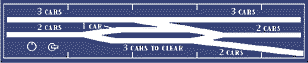 For full information about John Allen's switching game using this layout plan, see Adrian Wymann's classic website, "Model Railways Shunting Puzzles". |
||||||
LET'S BEGIN WITH THE CLASSIC DESIGN Michael Eckardt
from Hannover, Germany built this HOe [HOn30] version of the classic Timesaver
for his daughter at Christmastime two years ago. He found it so much
fun to switch that he has been using it ever since! The portable layout
measures 120x25cm (48x10in). It's shown here with five cars in place,
ready to be switched to their designated destinations (marked by the
roman-numeral standing cards, shown closeup below). Michael has taken
the layout to several exhibitions in and around Hannover. Michael Eckardt
from Hannover, Germany built this HOe [HOn30] version of the classic Timesaver
for his daughter at Christmastime two years ago. He found it so much
fun to switch that he has been using it ever since! The portable layout
measures 120x25cm (48x10in). It's shown here with five cars in place,
ready to be switched to their designated destinations (marked by the
roman-numeral standing cards, shown closeup below). Michael has taken
the layout to several exhibitions in and around Hannover.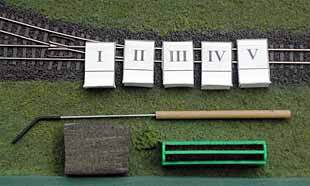 |
||||||
NEXT, A SMALL BUT LARGE-SCALE VARIATION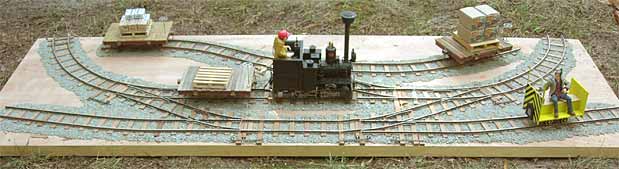 Carl Brummer, from Chesterfield Virginia USA, added another spur to Allen's design, and also made the scale a lot bigger! His 7/8-inch scale (1:13.7) layout is being built on a door measuring 70x36in (175x90cm). Carl uses Code 250 rail with link-and-pin couplers to help these big cars navigate the 18-inch (45cm) radii. Because of the tight curves, the links need to be about two inches long! Uncoupling occurs by hand, just as it did on the prototype. |
||||||
POST-WAR URBAN SHUNTING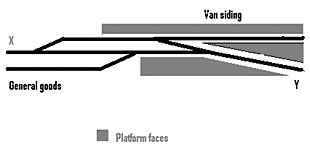 This Tymesaver-style switching layout was built by Martyn Mullender
from Portland, Dorset in England. Layout size is 4x1ft (120x30cm), set
in the early 1960s in an urban location such as East London. The
passenger station was closed during the War due to bomb damage (and a
nearby tube station), but still generates considerable freight traffic
so has remained open. One platform line is used for storing vans for
local fruit traffic serving the nearby market whilst the other siding
receives general merchandise mostly in open wagons. An operating
session begins with wagons placed as follows: This Tymesaver-style switching layout was built by Martyn Mullender
from Portland, Dorset in England. Layout size is 4x1ft (120x30cm), set
in the early 1960s in an urban location such as East London. The
passenger station was closed during the War due to bomb damage (and a
nearby tube station), but still generates considerable freight traffic
so has remained open. One platform line is used for storing vans for
local fruit traffic serving the nearby market whilst the other siding
receives general merchandise mostly in open wagons. An operating
session begins with wagons placed as follows:Three vans in Van Siding Five wagons in General Goods siding Three wagons held in the runaround siding (loop) 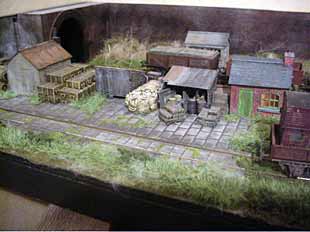 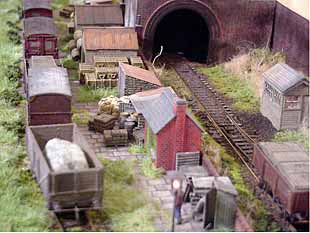 Each wagon is described on a card made up into a pack excluding the three cards in the loop. Three cards are withdrawn from the pack. These wagons must now be placed in the loop for dispatch and replaced by the three wagons in the loop. This process is not as easy as it sounds! A cunningly difficult arrangement of siding lengths prevents easy access and shunting, and considerable planning is required to complete the tasks. One of the pleasures of switching this layout is the well-observed scenery that Michael has concocted, shown in the photos. 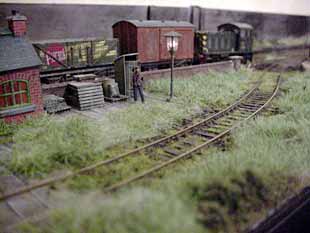 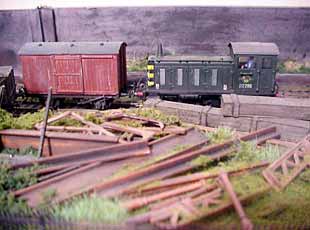 |
||||||
A BUSY CANADIAN BRANCH-LINE TYMESAVER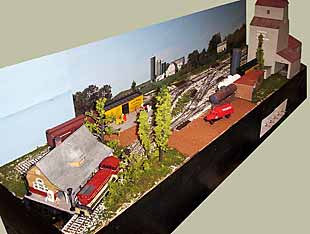 Stephen Christopher, who lives in Ontario, Canada, built the 1x4ft Pine Ridge Line in HO scale. His preliminary design
is featured in the Micro Layout Gallery on this site, but plans changed
during construction! The new layout plan can be seen on the control
panel (below). A fiddle track is located behind the grain elevator. Stephen Christopher, who lives in Ontario, Canada, built the 1x4ft Pine Ridge Line in HO scale. His preliminary design
is featured in the Micro Layout Gallery on this site, but plans changed
during construction! The new layout plan can be seen on the control
panel (below). A fiddle track is located behind the grain elevator.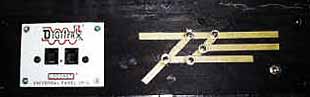 |
||||||
A FRENCH APPROACH TO U.S. RAILROADING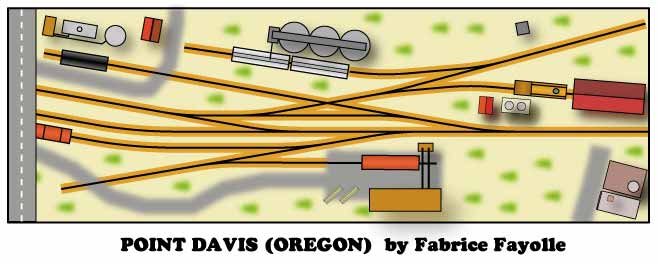 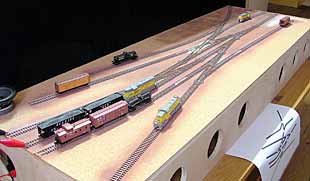 Fabrice Fayolle, from Amiens, France, is a frequent contributor to this Scrapbook. His latest project is an N-scale Tymesaver set in the U.S. state of Oregon. Point Davis measures
120x40cm (48x16in). We'll try to keep you updated on Fabrice's
progress, but meantime you can see up-to-the-minute bulletins at his website. Fabrice Fayolle, from Amiens, France, is a frequent contributor to this Scrapbook. His latest project is an N-scale Tymesaver set in the U.S. state of Oregon. Point Davis measures
120x40cm (48x16in). We'll try to keep you updated on Fabrice's
progress, but meantime you can see up-to-the-minute bulletins at his website. |
||||||
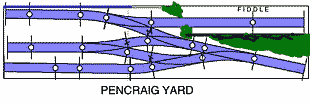
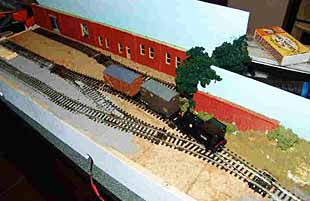
SWITCHING ACTION IN A WELSH VALLEY
|
||||||
PASSENGER SHUNTING AT THE BORDER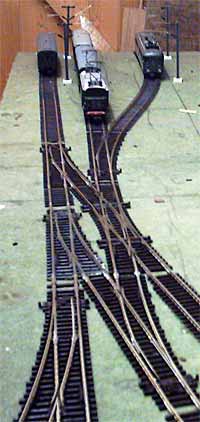 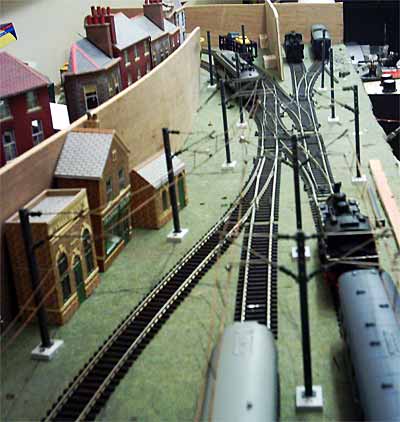 Andrew Smith, from Chelmsford, Essex in England, is building a passenger Tymesaver set on the German/Belgian border, using a few European coaches he found at an exhibition sale. The 72x20in (180x50cm) track plan, titled Wersisdas, is borrowed from my Amalgamated Terminal layout (mirror image). Operation will feature overhead wire and electric locomotives. Like me, Andrew enjoys the complex appearance of the trackwork at the terminal throat, and he plans an elevated station over the rear of the terminal tracks with stairs leading down to the platforms. The fiddle yard (at the far left end of the righthand photo) may become a sector plate at some point. We hope to keep in touch with Andrew's progress on this interesting layout -- stay tuned! |
||||||
HIDING ONE END OF THE RUNAROUND: 1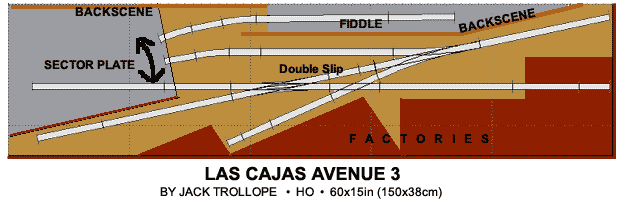 This plan, sent in by Jack Trollope from the Highlands of Scotland, is a variation on a variation! Jack drew a well-known classic micro layout plan, Box Street Yard, a few years back. Then Jeff Hartmann, from Long Beach, California USA, drew a smaller version of Box Yard and is building it under the title Las Cajas Avenue. And now, Jack has come up with yet another variant that runs modern-image U.S. rolling stock including 50-foot cars -- here's Las Cajas Avenue 3. It's HO, and uses some complex trackage made from standard Peco track pieces. It's an industrial switching district, lost in the canyons between tall factory buildings and forced to use complex track formations due to very limited available space. And what a lot of switching (shunting) opportunities there are in this limited space layout! "But is it a Tymesaver?" you may ask. I think it is ... one turnout at the left end of the runaround has been replaced by a hidden sector plate, but all the spurs function exactly as if they were offshoots from the runaround loop. So this layout works like a Tymesaver, even though part of the switching process will be conducted through a sector plate. Might even add to the fun! | ||||||
HIDING ONE END OF THE RUNAROUND: 2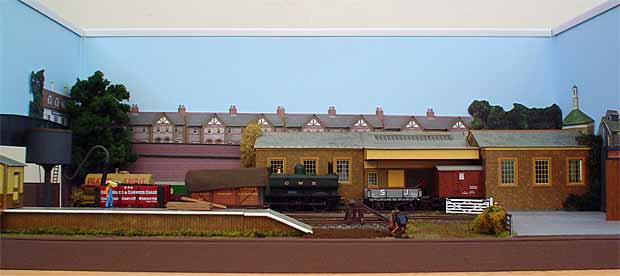 Here's another Tymesaver layout that hides one end of the runaround loop and replaces the turnout with, in this case, movable cassettes. This one, Steen Valley Yard, is a variation in OO scale of my layout, Peek's Pike, and was built by Ian Leadbeatter from Newcastle, New South Wales, Australia. 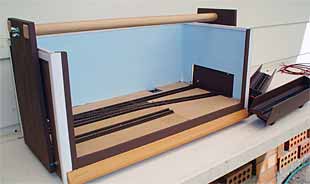 The
track plan is clear from this construction photo. Ian has added an
extension to the right to improve operations, and he uses cassettes to
fiddle the trains. This view of construction shows the bases of the
extension and the fiddle area in their upright, stowed positions,
locked together with a length of broomstick which serves as a
convenient carrying handle. Most of the time, reports Ian, he operates
the layout as an Inglenook switching game. The
track plan is clear from this construction photo. Ian has added an
extension to the right to improve operations, and he uses cassettes to
fiddle the trains. This view of construction shows the bases of the
extension and the fiddle area in their upright, stowed positions,
locked together with a length of broomstick which serves as a
convenient carrying handle. Most of the time, reports Ian, he operates
the layout as an Inglenook switching game.According to Ian, "The cassettes, controller and all the rolling stock fit into an old tackle box, so the whole thing is really portable. The buildings on the back drop are all pictures downloaded from the Superquick and Metcalf Models websites (again inspired by Peek's Pike), and the goods shed and platform are both card models by Superquick." 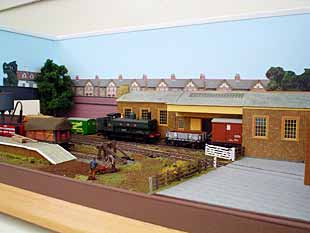 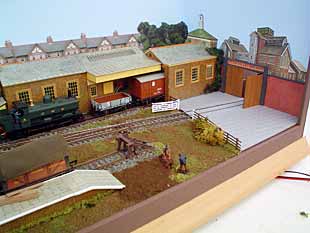 |
||||||
|
||||||